
SURVEY: AI simplifies employees’ work lives, but increases dependence on technology and fuels anxiety
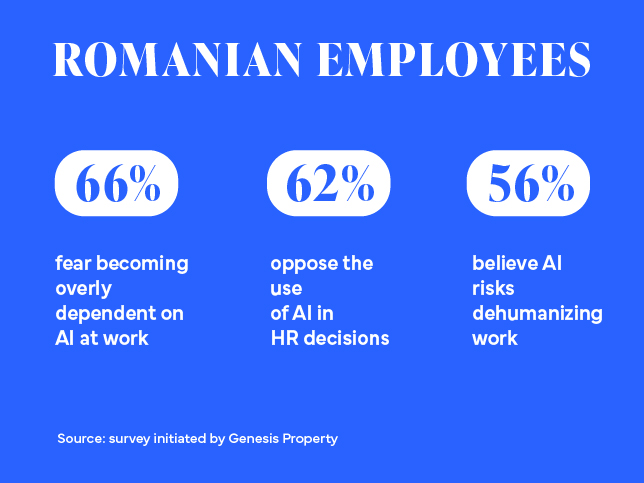

Artificial intelligence has become increasingly embedded in employees’ day-to-day work over the past year. More than 48% of employees see AI as a highly useful tool that simplifies their work; however, many remain concerned about the broader implications of its growing integration across all aspects of their activity, according to a survey conducted by Genesis Property at the beginning of this year, on a nationally representative sample of 1,146 employees. Nearly 66% of respondents are concerned about overdependence on AI at work, 56% believe it risks dehumanizing work, 40% approach the technology with caution regarding its impact on jobs, and 31% say it generates anxiety when it comes to long-term job security.
There are also clearly defined areas where employees believe artificial intelligence should not intervene at all, particularly when human dimensions of work are involved. Thus, 62% say AI should not be used for decisions that directly affect people, such as performance evaluations, promotions, or dismissals. More than half of respondents (53.6%) oppose the use of AI to assess emotions, motivation, or psychological state, while over 35% believe that interpersonal relationships and team dynamics should remain exclusively human. At the same time, 29.6% point to leadership and accountability as areas where decision-making and judgment cannot be delegated to technology, highlighting the need for a careful balance between automation and the human element, according to the survey.
Although technology contributes to increased productivity - by automating repetitive tasks (53%), enabling rapid data analysis (40%), and supporting creative activities (28%) - more and more employees believe that a recalibration is needed in how it is used in the workplace. Employees do not want less technology, but rather a more balanced work experience.
Thus, nearly 55% of respondents in the Genesis Property survey believe that technology in the office should be combined with elements that help them disconnect - from relaxation areas and spaces for team connection to outdoor offices or indoor environments with natural light, proper ventilation, plants, and other natural features. At the same time, to avoid digital overload, 34% of respondents say there is a need for dedicated areas for collaboration and human interaction without technology.
“We are seeing a meaningful shift in perspective: employees are not rejecting technology, but neither are they willing to accept it without limits. AI is welcomed where it simplifies work, yet it becomes a source of discomfort when it removes the human element entirely or is perceived as a control mechanism. In reality, beyond technological adoption, employees are seeking a balance between innovation and responsibility. They need both the tools that enhance efficiency and dedicated spaces that allow them to disconnect and engage meaningfully with colleagues”, said Elena Panait, Head of Leasing & ComYunitY la Genesis Property.
The tension between technology and the need for human connection is also beginning to reshape how employees envision the workplace, shifting the focus from pure digitalization or automation toward a more holistic work experience, one that balances technological capabilities with the human dimension. In this context, the concept of a “smart office” is no longer defined by the presence of more technology, but by technology that is seamlessly integrated and less intrusive. According to data from the Genesis Property survey, 37.3% of employees say they want a work environment that enhances efficiency while keeping decision-making in the human domain, while 35.2% prefer spaces where technology is almost invisible. At the same time, 31.4% of respondents are looking for offices that can adapt to different work needs, from focused tasks to collaboration or recovery, highlighting the growing expectation for a flexible, balanced, and employee-centric workplace.
When it comes to the technologies used, certain types of tools are perceived as intrusive and can generate anxiety. More than half of respondents (50.8%) identify activity monitoring systems as the main source of discomfort, while 42.9% are concerned about automated performance evaluations without a human layer of judgment. In this context, the office of the future is evolving into a hybrid space where technology and the human element coexist without canceling each other out. Work environments are no longer designed solely for productivity, but also for balance, ranging from efficient digital setups to disconnected areas dedicated to focus or meaningful, in-person interaction.
In this context of rapidly evolving employee expectations, office developers are being challenged to rethink how work environments are designed. For Genesis Property, development goes beyond delivering office buildings, focusing instead on creating work ecosystems that support both professional growth and employees’ personal wellbeing. YUNITY Park, the office campus founded by Liviu Tudor, reflects this approach through the integration of generous green spaces, relaxation areas, and amenities designed to enhance wellbeing. The project is currently in its third phase of development, backed by a total investment of €50 million.
The Genesis Property survey on working patterns and employees’ professional expectations in 2026 was conducted online at the beginning of this year, on a total sample of 1,146 internet users in Romania. Of these, over 53% are men, 76% are employees without managerial roles, and nearly 33% report a net monthly income exceeding 6,000 lei.